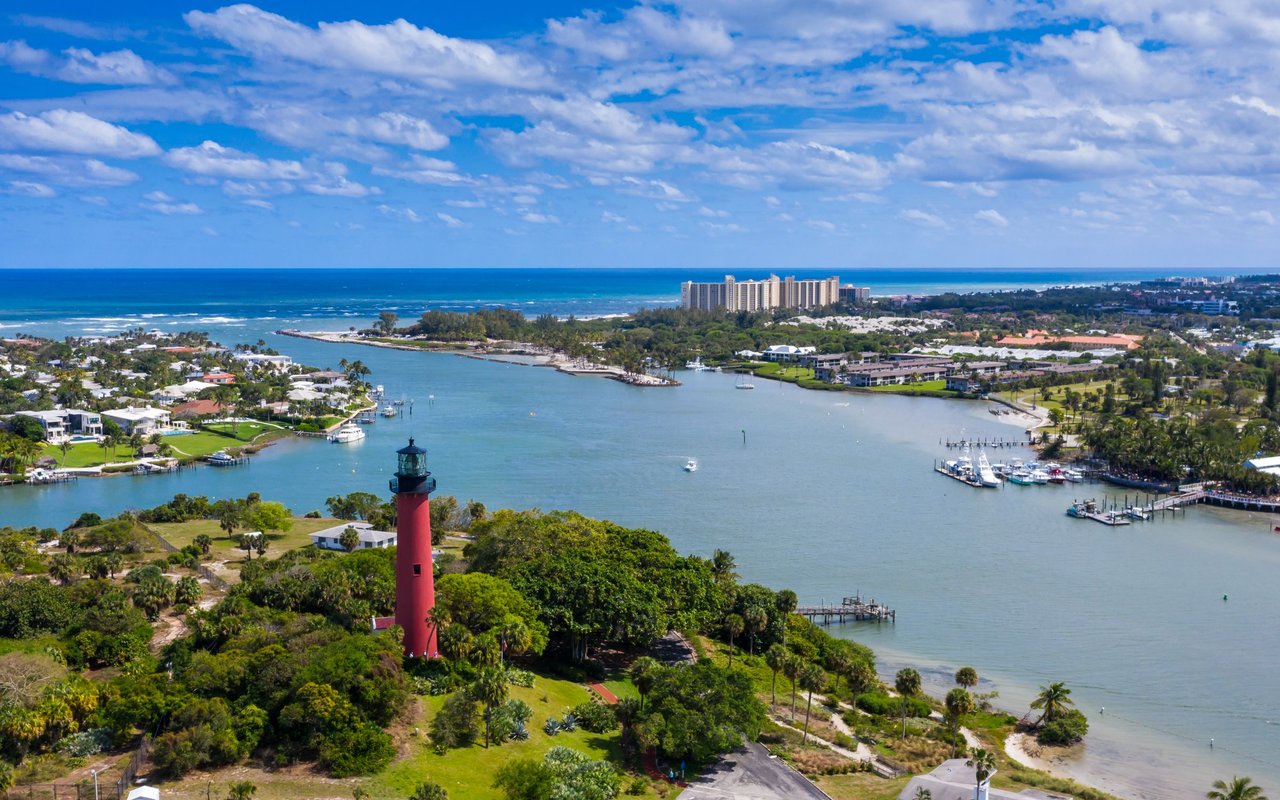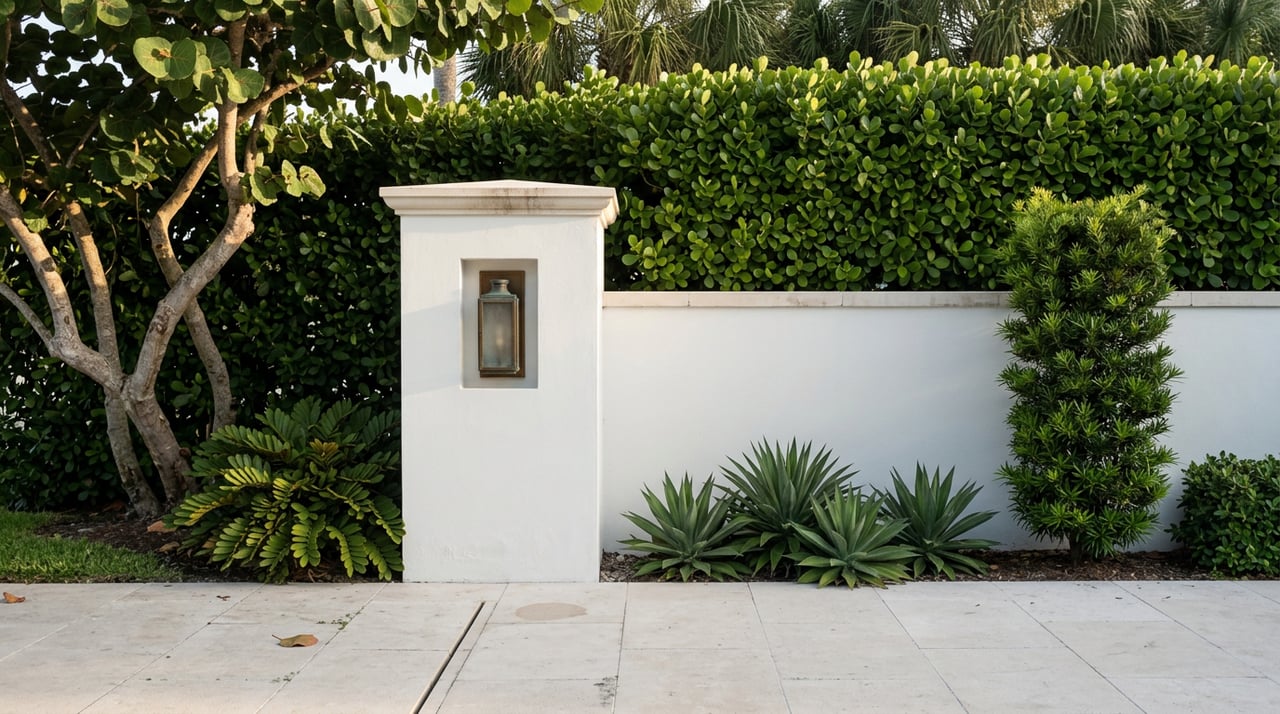
Workers are pouring the foundation for a new guardhouse at Point Manalapan this summer, a $100,000 structure with better sightlines, CCTV, license plate readers and an ADA-compliant restroom, replacing a shack that Town Manager Eric Marmer has said is more than 60 years old and in poor condition. A few hundred yards south, at the Boynton Inlet, the town just lost its grip on something it has been trying to control since before that old guardhouse was built. On August 13, an administrative hearing over the county's sand transfer plant, the one piece of infrastructure that decides how much beach Manalapan gets to keep, was postponed. Ocean Ridge is now a party to the case too.
Those two facts read like separate items in a town newsletter. They are not. One is a border Manalapan can finish on schedule. The other is a border it has been arguing about, and losing, since the plant went in.
A fight older than the town's own guardhouses
Harold Stirling Vanderbilt incorporated Manalapan in 1931. Six years later, in 1937, Palm Beach County built a sand transfer plant on the north side of the Boynton Inlet, on Manalapan's edge of the water. The plant pumps a slurry of sand and seawater through a pipe under the bridge and deposits it on the beach south of the inlet, in Ocean Ridge. Marmer has said it is well documented that residents objected to the arrangement in the 1930s and 1940s. Every legal challenge the town has filed since to modify how the plant operates has failed.
That losing streak matters for reading what happened this year. In 2025, the county received a 10-year permit extension allowing it to increase how much sand gets pumped off Manalapan's side of the inlet. The town's attorney, John Fumero, argues in an 18-page petition that this should have triggered a full review as a major modification, the kind that gives an affected town formal standing to object. Instead, the state approved it as a minor change. Manalapan was never given the chance to weigh in before the permit was final.
Fumero's petition lays out what he says is at stake if the extension stands: faster erosion, a smaller and lower-quality beach, damage to the natural resources of the state, less protection for the homes and roads behind the dune, and reduced turtle nesting habitat. The county and the state's environmental regulators have called the town's claims meritless.
What the postponement actually means
Here is the timeline that got the town to an empty hearing room this month:
- The county secures a 10-year permit extension in 2025, processed as a minor modification rather than a major one.
- Manalapan files a complaint with the Florida Department of Administrative Hearings in January 2026, asking Administrative Law Judge Francine Ffolkes to throw out the extension.
- A settlement meeting on July 10 fails to resolve anything.
- A five-day hearing is set to begin August 24 at the South Florida Water Management District's offices in West Palm Beach.
- On August 13, that hearing is postponed, and Ocean Ridge, the town on the receiving end of the sand, joins the case.
A postponement is not a ruling either way, and it is not new territory for a town that has been here before. What changed this round is who else showed up. Ocean Ridge has historically been the beneficiary of the plant's output, more sand on its shoreline, less on Manalapan's. Its decision to get involved suggests the erosion pattern on both sides of the inlet has shifted enough that even the town downstream of the pump has questions about how it's being run.
At a meeting on July 14, before the postponement, Marmer told residents the town would need a grassroots push to make its case. "We need a grassroots effort," he said, encouraging people to write letters and show up when the hearing finally happens.
This isn't a story with a resolution yet. It's a story about a mechanism. A permit extension that skips major review because a regulator labeled it minor is a procedural door that closes fast, and once it's shut, contesting it afterward means arguing in front of a judge instead of a public comment period. That's the door Manalapan has been trying to reopen since January, and it's the same door that's been closing on the town, in one form or another, since the 1940s.
The stakes wear a shell
Sea turtle nesting season is underway on this stretch of coast, and it isn't background noise to the sand fight, it's inside the legal argument itself. Fumero's petition specifically cites diminished turtle habitat as one of the harms of accelerated erosion. Beachfront lighting gets dimmed and shielded during nesting months precisely because a narrower, more disturbed beach makes it harder for turtles to nest and for hatchlings to find open water. The town's case and the annual ritual of dimmed porch lights along A1A are describing the same shrinking strip of sand from two different angles.
The part of town that is going according to plan
Contrast that with what's happening at the Point itself. The original guardhouse concept, an elaborate glass-enclosed design with a steel trellis overhead, would have cost as much as $340,000. After pushback, Currie Sowards Aguila Architects returned to the town's Architectural Commission in March with contemporary, coastal and Caribbean variations, scaled down to roughly the footprint of the current structure. Marmer put it plainly: the new version isn't the modern design first proposed, but it isn't the old shack either. The final price lands at $100,000, matching what the Town Commission had already set aside, and construction was expected to begin in July.
This is the guardhouse that sits at Point Manalapan, the entry point into the town's stretch of Hypoluxo Island. It is, in miniature, the kind of project a small town can actually finish: a budget, a design review process, a vote, a contractor. Nobody outside Manalapan needed to sign off.
Everyday life around town has kept moving in the same low-key register. Manalapan had no municipal election this March because Orla Imbesi, Dwight Kulwin and Elliot Bonner all qualified for their commission seats without opposition. Down at the Eau Palm Beach Resort & Spa, general manager Tim Nardi has walked the commission through a slate of ongoing projects, including a renovated Polpo restaurant, a new employee dining room, an upgraded fitness center and a new staff entrance on the building's north side. None of it requires a judge's signature.
Same argument, two rooms
Put the two threads next to each other and the pattern is hard to miss. At the Point, Manalapan controls the gate: it sets the budget, picks the design, and builds on its own timeline. At the inlet, it has spent nine decades asking someone else's permission to keep its own beach, and the answer, again and again, has been some version of no, or not yet, or you didn't have standing to ask.
The guardhouse will likely be finished before the sand fight is. That isn't a coincidence about construction schedules. It's the difference between a project a town owns outright and an argument it has to keep making to somebody else's regulator. Whatever the rescheduled hearing decides, the town's actual track record on this particular fight, going back to the 1930s, suggests residents shouldn't expect the postponement to be the last chapter.
If you're weighing what any of this means for property on this stretch of coast, from Manalapan through Hypoluxo Island and the barrier towns nearby, that's a conversation worth having with someone who follows these filings as closely as the listings. SERHANT. Palm Beaches tracks both. Schedule a private consultation with Christian Prakas to talk through what's actually happening on the ground here, beyond the newsletter version.